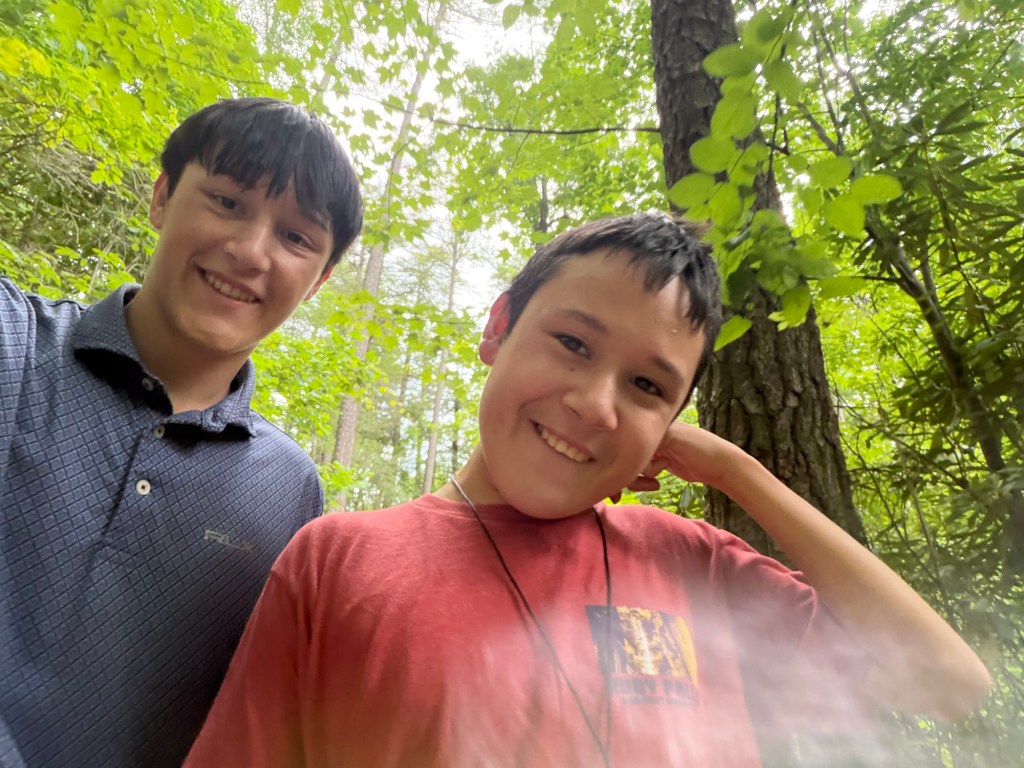
A few weeks ago we took another stroll up to the cabin and Cald, who had a road trip to Tennesee the week prior, couldn’t be more ecstatic to go again (with the promise of Chik-Fil-A obviously).The cabin was its usual adventure, with waterfalls and whatnot, but this time we decided to do a cave tour. From the moment we arrived, our guide seemed to understand Calder without needing a long explanation. She was patient. She never rushed him. She paid attention to what he needed instead of expecting him to keep pace with everyone else. There was no frustration in her voice, no awkwardness, just kindness that felt completely natural.
She told the group the usual geological facts, but gave Cald and me a fun fact. When she was in preschool, she had become friends with a nonverbal boy in her class. At nap time, she would gently give him back massages because it helped him relax enough to fall asleep. She didn’t tell me the story to impress anyone. To her, it was simply something you do when you care about another person.
I thought about how remarkable that really was. She had learned, even as a child, that helping someone doesn’t always look the same. Sometimes it means speaking less. Sometimes it means waiting longer. Sometimes it means understanding that what calms one person may overwhelm another.
One of the biggest misconceptions about autism and other disabilities is the idea that there is a universal approach. There isn’t.
Every child is different.
Some children seek out noise while others spend every day trying to escape it. Some crave movement while others find comfort in stillness. Some communicate through words, others through gestures, devices, expressions, or simply by trusting the people around them to understand. Some benefit from occupational therapy, sensory tools, routines, or quiet spaces. Others need something entirely different.
There isn’t a single formula because there isn’t a single child.
The people who make the biggest difference are rarely experts reciting a textbook. They’re the people who notice. The ones who ask instead of assume. The ones who understand that patience isn’t simply waiting; it’s adapting.
That cave guide reminded me that countless people have crossed paths with children like Calder throughout their lives. A classmate. A cousin. A neighbor. A student. A camper. A friend. Every encounter teaches something new because every child teaches something different.
The best gift we can give isn’t pretending everyone’s needs are identical.
It’s taking the time to discover what helps the person standing in front of us.
For one little boy in preschool, it was a back massage during nap time.
For Calder, it’s probably Chik-Fil-A.

 Autism | Calderism
Leave a comment